Basketball Odds Comparison Across UK Bookmakers
 Available in US
Securing Maximum Value Through Basketball Odds Comparison
January 2024. I backed the Celtics at -6.5 on a spread at 1.91 — the first price I saw on my default sportsbook. The Celtics won by six. Push at -6, loss at -6.5. After the game I checked two other platforms out of morbid curiosity: one had the same game at -6.0 at 1.90. Half a point, same odds near enough. If I had spent 30 seconds checking, that bet would have been a push instead of a loss. The £25 I lost was the price of laziness, and I have not paid that price since.
Odds comparison in basketball betting is not a sophisticated strategy. It is a mechanical habit — a process you follow before every bet that requires no analytical skill, no statistical modelling, and no insider knowledge. You look at the same market on three or four sportsbooks and take the best available price. It is the closest thing to free money that exists in sports betting, and most UK basketball bettors do not bother because the improvement per bet feels insignificant. Over a season, it is anything but.
Why Basketball Odds Vary Between UK Sportsbooks
Every UK-licensed sportsbook sets its own odds based on its own models, its own risk exposure, and its own commercial priorities. Two sportsbooks looking at the same Lakers-Warriors game will arrive at slightly different prices because they weight different inputs — one might lean more heavily on recent form, another on season-long metrics, a third on its own customer betting patterns. These differences are small on any individual market, but they exist on every market, and they add up relentlessly.
The spread is where variance between sportsbooks is most meaningful. A half-point difference on a basketball spread — -5.5 versus -6.0 — changes the outcome of the bet in roughly 3-4% of games. That number sounds small until you realise that most profitable bettors operate on edges of 2-5%. A bettor who consistently takes -5.5 instead of -6.0 when the market offers both has added a structural advantage that requires zero additional skill. It is pure execution discipline.
Totals vary less frequently between sportsbooks but still produce meaningful differences. One platform might set the total at 224.5 while another has 225.5. In a sport where the average game lands within two points of the total roughly 15% of the time, that one-point difference is not trivial. I have had months where the majority of my winning total bets would have been losers if I had taken the price from my second-choice sportsbook instead of my first.
How to Compare Basketball Odds Efficiently
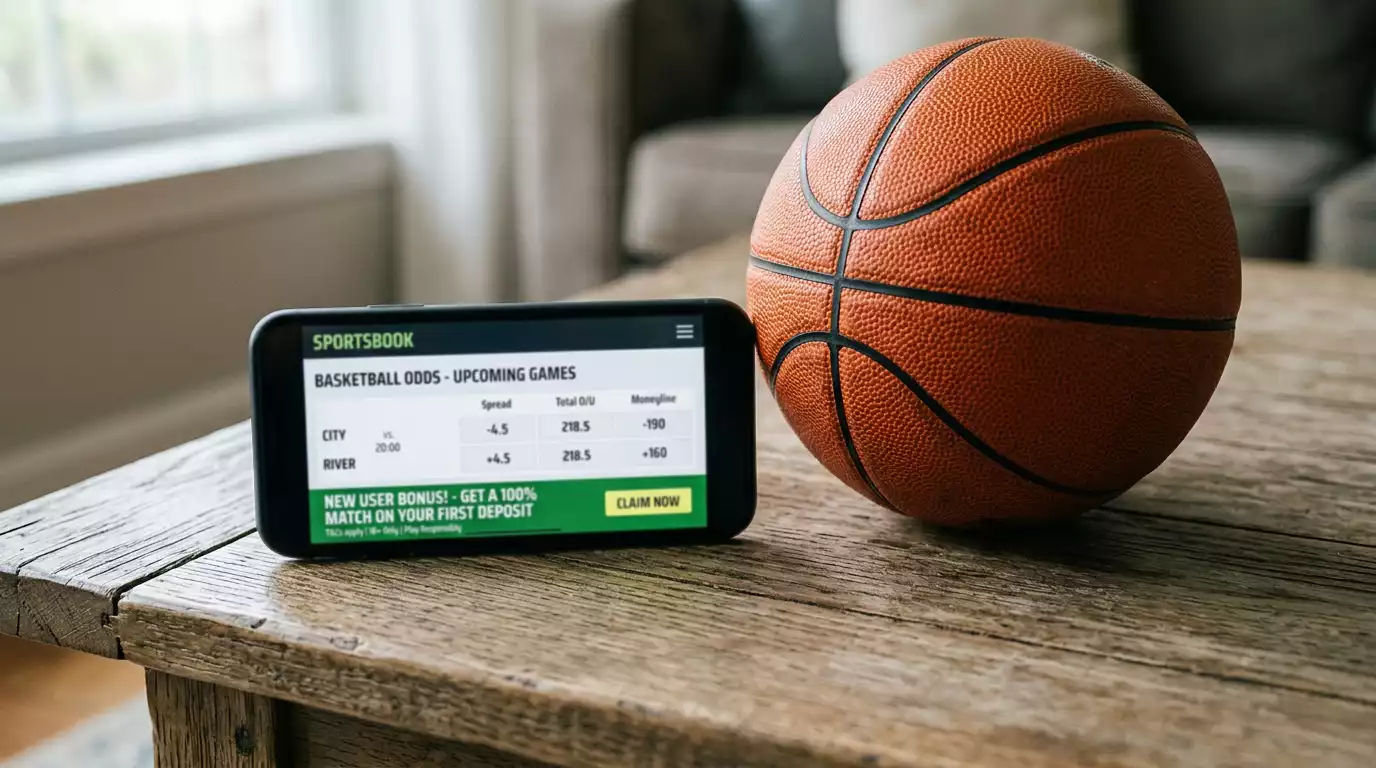
The manual approach works for pre-match bets and takes less than two minutes. Open the basketball section on three or four sportsbook apps, navigate to the same game, and compare the spread, total, and moneyline side by side. Once you have done this a few dozen times, you develop a sense for which sportsbooks tend to offer better prices on which markets — one might consistently offer tighter spreads while another gives better moneyline value on underdogs. This pattern recognition speeds up future comparisons.
Odds comparison websites aggregate prices from multiple sportsbooks into a single view, which saves the step of opening four apps individually. These are useful as a starting point but come with caveats. The prices displayed are not always real-time — they may lag by seconds or minutes, which matters for markets that move frequently. They also tend to focus on main markets (moneyline, spread, total) and miss player props, quarter lines, and other secondary markets where price differences can be even larger. Use comparison sites for a quick scan; confirm the actual price on the sportsbook itself before placing.
For live betting, real-time odds comparison is impractical. The markets move too fast and your attention needs to be on the game rather than tabbing between apps. My approach for live basketball bets is simpler: I have identified which of my sportsbook accounts has the best live basketball interface and the most competitive live pricing, and I default to that platform during in-play sessions. The live pricing leader for basketball is not always the same sportsbook that leads on pre-match odds, so this is worth testing independently.
The Compound Impact of Better Odds Over a Season
Let me make this concrete with numbers. Suppose you place 300 basketball bets per NBA season at an average stake of £20. If you consistently take odds of 1.95 instead of 1.90 — a 0.05 improvement that odds comparison routinely delivers — your expected return improves by £1.00 per winning bet. If you win 52% of your bets at 1.95 (a solid but achievable rate for a disciplined bettor), you win 156 bets. That is £156 more in your pocket than if you had taken 1.90 every time. On a total outlay of £6,000 across the season, £156 is a 2.6% improvement in return — and in a market where the sportsbook hold rate averages 10.15%, recovering 2.6% of that margin through nothing more than price-checking is enormous.
The effect is even larger on spread bets where the half-point difference changes the outcome. Using the same 300-bet example, if half-point line shopping changes the result of 3-4% of your spread bets from a loss to a push (or a push to a win), that is 5-6 bets per season that flip in your favour. At £20 per bet, that is another £100-120. Combined with the odds improvement, you are looking at roughly £250-275 of additional return per season from a habit that adds 90 seconds to each bet placement. I cannot think of a higher-return-per-minute activity in all of sports betting.
Which Markets Reward Comparison Most
Not all basketball markets benefit equally from odds comparison. Main markets — spread, moneyline, total — are priced most competitively because they attract the most volume and the most scrutiny from the sportsbooks’ trading desks. Differences exist but are smaller. Player props, quarter lines, alternative spreads, and same-game parlay components show larger price variation because they are priced with less precision and adjusted less frequently.
I have found the widest odds discrepancies on NBA player props. A player’s points over/under might be 23.5 at 1.85 on one sportsbook and 22.5 at 1.87 on another. That is not just a price difference — the line itself is different by a full point. Checking three platforms for the same player prop regularly reveals these gaps, and they are large enough to change the expected value of the bet from negative to positive. If you are serious about protecting your bankroll, prop comparison is where the most value hides.
Alternative spreads and totals also vary significantly. One sportsbook might offer an alternative total of 210.5 at 1.72 while another has the same alternative at 1.80. The underlying market is identical — the operator simply prices its alternative lines differently based on its risk model. These are low-hanging opportunities that take seconds to find and require no analytical insight beyond the willingness to check a second screen.
Building the Habit Into Your Betting Process
The reason most bettors do not compare odds is not that they do not understand the value — it is that the habit is not embedded in their process. They open their favourite app, find the game, see a price that looks reasonable, and place the bet. Adding a comparison step feels like unnecessary friction when you are confident in your selection. But the selection and the price are independent decisions. Being right about the outcome and being wrong about the price still costs you money — less money than being wrong about both, but more than you needed to lose.
I solved this by making comparison the first step, not the last. Before I even decide whether to bet a game, I check the odds on all my platforms. This front-loads the comparison into the research phase rather than bolting it onto the execution phase. By the time I have decided to bet, I already know which platform offers the best price, and placing the bet is a single tap rather than a multi-app comparison under time pressure.
Three sportsbook accounts is the practical minimum for meaningful comparison in UK basketball betting. Four is better. More than five adds diminishing returns unless you are also arb betting, where maximum coverage matters. Each account needs to be funded with enough balance to place your standard bet without needing a deposit — because a deposit step between spotting the best price and placing the bet introduces delay that can cost you the line. Pre-fund your accounts at the start of each month and treat the balances as a single pool distributed across platforms.
How much difference does odds comparison make in basketball betting?
Over a season of 300 bets, consistently finding odds 0.05 better in decimal terms, combined with half-point line improvements on spreads, can add roughly £250-275 to your returns. This requires no analytical skill — just the habit of checking three or four sportsbooks before every bet.
Which basketball markets show the biggest odds differences between UK sportsbooks?
Player props and alternative lines show the widest price discrepancies. Main markets like spreads, moneylines, and totals are more competitively priced but still produce meaningful differences, particularly on the spread where a half-point can change the outcome in 3-4% of games.
Written by the editors at bet Basketball Game.