Common Basketball Betting Mistakes and Solutions
 Available in US
- Avoiding Common Bankroll Errors and Basketball Betting Mistakes
- Betting the NBA Like It Is the Premier League
- Chasing Losses During Late-Night NBA Sessions
- Ignoring Rest Days, Back-to-Backs, and Travel
- Overvaluing Recent Results and Small Samples
- Neglecting Line Shopping Across Multiple Sportsbooks
- Treating Accumulators as a Shortcut to Big Returns
Avoiding Common Bankroll Errors and Basketball Betting Mistakes
This is not a theoretical list of things that might go wrong. Every mistake I describe here is one I made personally, tracked in my betting records, and quantified in pounds lost. Some were one-off errors that taught sharp lessons. Others were recurring habits that bled my bankroll slowly over weeks before I recognised the pattern. The uncomfortable truth about basketball betting mistakes is that most of them feel correct in the moment — that is precisely why they persist. The fastest way to lose your funds is by ignoring proper basketball betting bankroll management during an inevitable cold streak.
I am writing this for UK bettors who are past the absolute beginner stage. You know what a spread is, you understand how odds work, and you have placed enough bets to have a track record worth examining. The mistakes that cost beginners money — not understanding the bet type, misreading odds formats — are covered elsewhere. These are the errors that experienced bettors make, the ones that are harder to spot because they hide behind reasonable-sounding logic.
Betting the NBA Like It Is the Premier League
Most UK bettors come to basketball from football, and they bring football instincts with them. This is the single most costly mistake I see among UK basketball punters, and it took me an entire season to break the habit. Football and basketball are structurally different sports for betting purposes, and the strategies that work in one often fail in the other.
In football, home advantage is significant — historically around 1.5 goals worth of edge. In the NBA, home advantage has shrunk to roughly 2-3 points and continues to decline. Backing the home team reflexively, as many football bettors do, produces no edge in basketball and often leads you toward overpriced favourites. I tracked my first 100 NBA bets and discovered that 73 of them backed the home side. My strike rate was 48% — worse than a coin flip once you account for the juice.
The draw does not exist in basketball. NBA games always produce a winner, which simplifies the market but also means the moneyline carries less value than in football, where the draw outcome creates inefficiency. Basketball bettors who ignore the spread and bet only moneylines are leaving the most analytically rich market on the table. The spread is where the real action happens in basketball, and if you are not comfortable with it, you are competing with one hand tied behind your back.
Chasing Losses During Late-Night NBA Sessions
NBA games tip off at 11pm, midnight, and 1am UK time. You start the evening with a plan — two or three bets on the early games. The first two lose. It is now 1:30am, there are still games running on the West Coast, and the temptation to chase your losses with a quick bet on the late game is overwhelming. You are tired, frustrated, and making decisions with a brain that has been running on declining cognitive reserves for hours.
I lost more money chasing late-night losses than on any other single behaviour pattern. The late games are not inherently worse for betting — the markets are the same — but your decision-making at 2am is measurably worse than at 11pm. I now have a hard rule: my last pre-match bet goes in before midnight, and I do not add to my card after that regardless of how the evening is going. If I am live betting, I stop after the third quarter of whatever game I am watching. No exceptions.
The maths reinforces this. The sportsbook hold rate has risen from 6.7% to 10.15% across the industry, which means you are paying roughly a 10% tax on every bet through the margin. Chasing losses does not reduce the margin; it multiplies the number of times you pay it. Two losing bets followed by a chase bet means you have paid the house edge three times instead of twice. The chase bet needs to win at a higher rate than your normal bets just to break even — and it will not, because you are making it with less analysis and more emotion.
Ignoring Rest Days, Back-to-Backs, and Travel
The NBA schedule is a 30-team logistics operation spanning six months and thousands of miles of travel. Teams play 82 games, which means back-to-back games (two games on consecutive nights), four-games-in-five-nights stretches, and cross-country flights that land at 3am before an afternoon tip-off. These schedule factors affect performance in measurable, consistent ways — and most casual bettors ignore them entirely.
A team on the second night of a back-to-back, playing away, against a rested opponent is at a tangible disadvantage. The data shows roughly a 1.5-to-2-point performance decline in these spots. The sportsbook adjusts for this, but not always fully. I check the schedule context for every game I consider betting: When did this team last play? Did they travel? Is this the first or second night of a back-to-back? How many games have they played in the last seven days? These questions take three minutes to answer and have saved me from dozens of bad bets.
The trap is assuming the sportsbook has not already accounted for schedule factors. It usually has — partially. A three-point spread between a rested home team and a road team on a back-to-back might be set at -5.5 instead of -3.5 to reflect the schedule disadvantage. The question is not whether the adjustment exists but whether it is large enough. Sometimes a 2-point schedule adjustment is correct; sometimes the market gives only 1.5 points when the situation warrants 3. That gap is where the edge lives, and you cannot see it unless you are checking the schedule.
Overvaluing Recent Results and Small Samples
A team wins five straight games and the public loads onto them. A player scores 35 points in consecutive games and his prop line jumps. Recent results feel predictive because human brains are wired to see trends even in random sequences. In basketball betting, this bias — called recency bias — costs money consistently because the market amplifies it. Casual bettors chase hot streaks, sportsbooks adjust the lines to exploit that behaviour, and the result is overpriced favourites and overpriced overs on players riding short-term shooting heats.
Five games is not a meaningful sample in the NBA. Neither is ten. A team’s true performance level emerges over 25-30 games, and even then it shifts as injuries, trades, and rotational changes alter the roster. I weight the most recent ten games more heavily than the full season for pace and efficiency metrics, but I never treat a five-game streak as evidence of a fundamental change. Sometimes a team wins five straight because they played well; sometimes they won five straight because their schedule was soft and they caught a few lucky bounces. The underlying performance data tells you which, but only if you are looking at it instead of the win-loss record.
Player props are especially vulnerable to this mistake. A guard who averages 22 points per game scores 31 and 34 in back-to-back games, and his prop line jumps from 22.5 to 25.5. The market is pricing the recent explosion, not the 60-game body of work that says he is a 22-point scorer. Unless something structural changed — a new starting lineup, an injured teammate creating more usage — the bump is an overreaction, and the under at 25.5 represents value that the under at 22.5 did not.
Neglecting Line Shopping Across Multiple Sportsbooks
This one embarrasses me because I know better and I still catch myself being lazy about it. Line shopping — comparing the odds for the same market across multiple UK sportsbooks — is the simplest, most reliable way to improve your long-term results. Getting 1.95 instead of 1.90 on every bet does not feel significant in the moment, but over 200 bets in a season it is the difference between a losing record and a break-even one. Over 500 bets it is the difference between break-even and profitable.
The UK sportsbook market is competitive enough that prices on NBA games vary meaningfully between operators. A spread of -4.5 at 1.91 on one platform might be -4.5 at 1.95 on another — or the spread itself might differ, with one sportsbook offering -4.0 while another sits at -5.0. That half-point on the spread is not cosmetic; it changes the probability of your bet winning. Having accounts at three or four UKGC-licensed sportsbooks and checking each one before placing a bet takes less than two minutes and has a larger impact on your bottom line than any analytical framework.
I keep my most-used sportsbook apps in a single folder on my phone and check all of them before confirming any pre-match bet. For live bets, where speed matters more, I default to whichever platform has the best basketball live betting interface — but for pre-match wagers, there is no excuse for not shopping the line. If you are reading this and placing every bet on one platform without checking alternatives, this single change will improve your results more than anything else in this article. It is free, it is fast, and it directly addresses the hold rate that the sportsbooks build into every market.
Treating Accumulators as a Shortcut to Big Returns
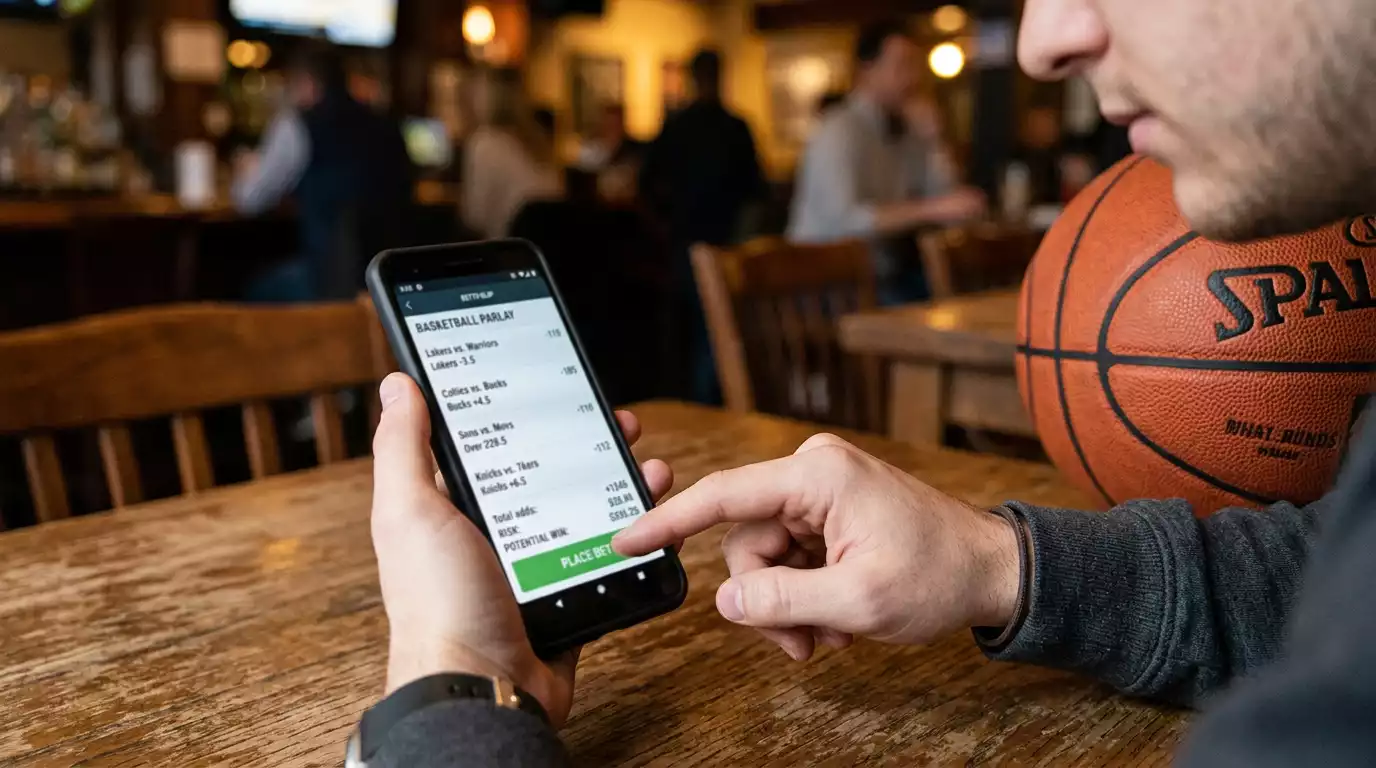
I understand the appeal of accumulators. A four-leg NBA acca at combined odds of 12.0 turns a £10 stake into £120 — the kind of return that a single bet at 1.90 cannot match. But the maths behind accumulators is the most misunderstood concept in UK sports betting, and basketball accas are no exception. Each leg you add to an accumulator multiplies the sportsbook’s margin as well as your potential return. A four-leg acca with a 5% margin on each leg carries a cumulative margin of roughly 18.5%. You are paying nearly a fifth of your stake to the house before a single basket is scored.
I still place the occasional basketball accumulator — they have their place as entertainment bets with small stakes. But I separated my acca activity from my serious betting years ago. The money I allocate to accumulators comes from a different mental bucket than my analytical single bets, and I track them separately in my records. Over three seasons, my single bets have shown a positive return. My accumulators have shown a loss roughly equal to the expected cumulative margin. That is not a coincidence; it is the maths working exactly as it should.
If you enjoy basketball accumulators, set a strict weekly budget for them and treat them as the entertainment product they are. Do not conflate acca results with your overall betting performance, and do not increase your acca stakes because a near-miss four-legger made you feel like you were close to a big win. You were not close. A three-of-four accumulator is a losing bet, and it is no closer to a four-of-four than any other losing bet. The narrative of the near-miss is the most effective sales tool the sportsbook has, and it is designed to keep you coming back with bigger stakes. Learn how to protect your stakes and grow your balance with the experts at bet Basketball Game.
What is the most common basketball betting mistake UK bettors make?
Applying football betting instincts to basketball — particularly overvaluing home advantage, ignoring spread markets in favour of moneylines, and underestimating the impact of NBA schedule factors like back-to-back games and travel fatigue.
How do I stop chasing losses on late-night NBA bets?
Set a firm cut-off time before you start your evening session — placing no new bets after midnight, for example — and commit to it regardless of how earlier bets performed. The sportsbook margin is the same at 2am, but your decision-making quality is measurably worse.
Does line shopping really make a difference in basketball betting?
Yes. Getting slightly better odds on every bet — even 0.05 in decimal terms — compounds over hundreds of bets into a meaningful impact on your bottom line. Having accounts at three or four UK sportsbooks and checking each before placing a pre-match bet is the simplest improvement most bettors can make.
Created by the ”bet Basketball Game” editorial team.