Basketball Betting Glossary and Wagering Terms
 Available in US
Essential Terminology in the COURTSIDE Basketball Betting Glossary
When I started betting on basketball from the UK, I understood football betting terminology perfectly — accumulators, each-way, handicaps, draw no bet. Then I opened an NBA betting market and encountered moneylines, point spreads, juice, the vig, props, parlays, and over-unders all at once. Some of these terms overlapped with concepts I already knew under different names. Others were genuinely new. The confusion did not just slow me down — it cost me money, because I placed bets without fully understanding what I was agreeing to.
This glossary is organised by category rather than alphabetically, because understanding basketball betting terms in isolation is less useful than understanding how they relate to each other. A “push” only makes sense if you understand “spreads.” The “vig” only matters when you grasp how odds are priced. I have grouped the terms the way they connect in practice, so reading through each section builds a framework rather than a list of disconnected definitions.
Core Bet Types
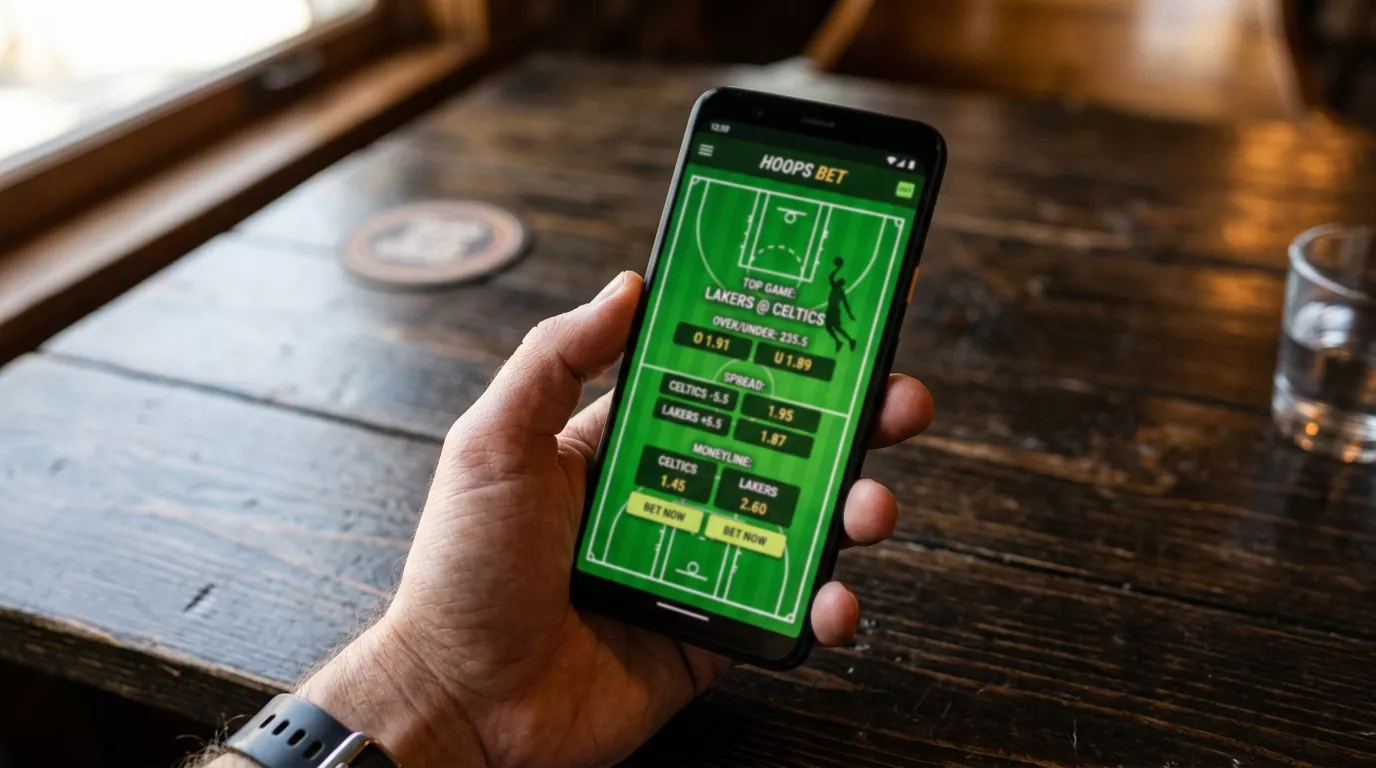
Moneyline — A bet on which team will win the game outright. No points are added or subtracted. If you back the Celtics on the moneyline and they win by one point or fifty, you win your bet. In UK football terms, this is the closest equivalent to a “match result” bet, except basketball has no draw — one team always wins. Overtime counts.
Point spread — A bet that includes a handicap to level the playing field between favourite and underdog. If the Celtics are -6.5, they must win by seven or more points for your bet to win. If you back the underdog at +6.5, they can lose by up to six points and you still win. UK bettors will recognise this as a handicap bet, though the term “spread” is more common in basketball.
Over/under (totals) — A bet on the combined final score of both teams. The sportsbook sets a line — say 218.5 — and you bet whether the actual combined score will be higher (over) or lower (under). This market strips the game down to a single question about scoring volume and is influenced heavily by pace, defensive intensity, and playing style.
Push — When the final result lands exactly on the spread or total line, resulting in a tie against the number. Your stake is returned with no profit or loss. Half-point lines (like -6.5 or 218.5) are designed to eliminate pushes. Whole-number lines (like -7.0 or 220.0) create push possibilities.
Player prop (proposition bet) — A bet on an individual player’s statistical performance rather than the game outcome. Common props include points scored, rebounds, assists, three-pointers made, and combined stat markets (points + rebounds + assists). The sportsbook sets a line and you bet over or under.
Futures — Long-term bets on outcomes that will not be decided for weeks or months. NBA championship winner, conference winner, MVP, and regular-season win totals are all futures markets. These bets tie up your stake for extended periods but can offer value when placed early in the season before the market firms up.
Accumulator (parlay) — A single bet combining multiple selections. All legs must win for the bet to pay out. The combined odds multiply together, creating large potential returns from small stakes — but the cumulative probability of winning drops with each added leg. UK bettors know these as accas; the American term is parlay.
Same-game parlay (SGP) — An accumulator where all legs come from the same game. You might combine a team to win, a player to score over 25 points, and the total to go under 220 — all from one NBA game. Pricing on SGPs is adjusted by the sportsbook to account for correlation between legs.
Odds and Pricing Terms
Decimal odds — The format most commonly displayed on UK sportsbooks. The number represents your total return per £1 staked, including your stake. Odds of 1.90 mean a £10 bet returns £19.00 (£9.00 profit plus your £10 stake).
Fractional odds — The traditional UK format showing profit relative to stake. Odds of 9/10 mean you profit £9 for every £10 staked (equivalent to 1.90 in decimal). Less common on basketball markets than on horse racing or football, but some UK sportsbooks still offer the option.
American odds (+/-) — The format used by US sportsbooks and often displayed on NBA-focused content. Positive numbers (+150) show how much you profit on a £100 stake. Negative numbers (-150) show how much you need to stake to profit £100. UK bettors encounter these when reading American NBA analysis or using US-facing comparison tools.
Implied probability — The probability of an outcome as suggested by the odds. Decimal odds of 2.00 imply a 50% probability (1 divided by 2.00). Comparing implied probability to your own assessment of the true probability is how you identify value bets — situations where the odds are longer than the actual likelihood suggests.
Overround (vig, vigorish, juice) — The sportsbook’s built-in margin. If the true probabilities of a two-outcome market add up to 100%, the implied probabilities from the offered odds will add up to more than 100% — the excess is the overround. An overround of 105% means the sportsbook expects to keep about 5% of all money wagered on that market regardless of the outcome. The hold rate across UK sportsbooks has increased from 6.7% in 2018 to 10.15% as pricing models have improved.
Line — The odds or spread number set by the sportsbook for a specific market. “The line on the Celtics is -6.5” means the spread is set at 6.5 points in their favour. “The line moved” means the odds or spread changed after the market opened.
Line movement — Changes in the odds or spread after the market opens, driven by betting volume, injury news, or sharp action. A spread that opens at -5.5 and closes at -7.0 has “moved” two points, suggesting heavy action on the favourite.
Market and Strategy Terms
In-play (live betting) — Bets placed after the game has started. Live markets adjust continuously based on the score, time remaining, and game flow. In-play wagering accounts for 62.35% of all online sports betting globally and is particularly popular in basketball due to the sport’s constant scoring.
Cash out — An option offered by sportsbooks to settle a bet before the event concludes, locking in a profit or limiting a loss based on the current situation. The cash-out price always includes a margin for the sportsbook, meaning you receive less than the mathematically fair value of your position.
Hedge — Placing a bet on the opposite side of an existing wager to guarantee a profit or reduce risk. If you have a futures bet on the Celtics to win the championship and they reach the Finals, hedging with a bet on their opponent guarantees you profit regardless of who wins the series.
Sharp (sharp bettor) — A professional or highly skilled bettor whose wagers influence line movement. When sharps bet heavily on one side, sportsbooks move the line to balance their exposure. “Sharp action on the under” means sophisticated bettors are driving the total downward.
Square (recreational bettor) — A casual bettor whose wagers are based more on fandom, intuition, or public narrative than on analytical process. Sportsbooks profit most from square bettors and set their initial lines partly based on predicted square betting patterns.
Closing line value (CLV) — The difference between the odds you took and the odds at the moment the market closes (game tip-off). Consistently beating the closing line — getting better odds than the final price — is the strongest predictor of long-term betting profitability. If you took -5.5 and the line closed at -7.0, you captured 1.5 points of CLV.
Handle — The total amount of money wagered on a market or event. Americans wagered $166.94 billion on sports in 2025, with basketball accounting for approximately 28% of total handle. Higher handle generally means more efficient pricing.
Hold (hold rate) — The percentage of total handle the sportsbook keeps as revenue. A 10% hold rate means the sportsbook retains £10 of every £100 wagered across all outcomes of a market.
Basketball-Specific Betting Terms
Quarter and half bets — Markets on the outcome of individual quarters or halves rather than the full game. First-quarter spread, second-half total, and fourth-quarter moneyline are common examples. These markets carry higher variance but can offer value when a bettor has specific knowledge about team tendencies in particular game phases.
Alternative spread / alternative total — Lines set at numbers different from the main line. If the main spread is -6.5, alternative spreads might range from -1.5 to -12.5 at adjusted prices. These let you buy or sell points to match your confidence level, trading odds for a more or less favourable line.
Micro betting — Markets on very short segments of a game, such as the outcome of the next possession, the next player to score, or whether the next free throw will be made. NBA games now generate over 1,800 individual markets per game through micro betting offerings. These are high-frequency, high-margin markets that suit bettors who thrive on rapid decision-making.
Bet builder (request-a-bet, build-a-bet) — A tool that lets you combine multiple selections from the same game into a custom bet. Unlike standard accumulators, bet builders allow correlated selections from within a single match. The sportsbook prices these using correlation models and typically adds margin for the customisation.
Cover — When a team wins by enough points to beat the spread. “The Celtics covered” means they won by more than the spread demanded. An underdog “covers” if they lose by fewer points than the spread or win outright.
ATS (Against the Spread) — A team’s record against the point spread rather than straight up. A team might be 30-20 in wins and losses but 28-22 ATS if they frequently win by fewer points than the spread requires. ATS records are a more useful indicator of betting performance than win-loss records.
Understanding these terms is the foundation — applying them is where the edge develops. If you are building your basketball betting vocabulary from scratch, pair this glossary with the practical guides linked throughout this site, starting with the beginners guide for a step-by-step introduction to placing your first basketball bets as a UK bettor.
What does ‘cover the spread’ mean in basketball betting?
Covering the spread means a team has won by enough points to beat the point spread handicap. If the Celtics are -6.5 and win by 10, they covered the spread. If they win by only 5, they won the game but did not cover.
What is the vig in basketball betting?
The vig (vigorish), also called juice or overround, is the sportsbook’s built-in margin on a market. It ensures the sportsbook profits regardless of the outcome. On a standard NBA spread bet, the vig is typically reflected in odds of 1.90-1.91 on each side rather than the true-odds 2.00.
What is the difference between a parlay and an accumulator?
They are the same thing — a single bet combining multiple selections where all legs must win. ‘Parlay’ is the American term used in NBA contexts; ‘accumulator’ or ‘acca’ is the UK equivalent. The mechanics, risks, and margin structure are identical.
Prepared by the bet Basketball Game editorial staff.